
IT INTEGRATION
I have been working as an IT Integrator for many years, fortunate to collaborate with a diverse range of teams across various disciplines, including development, operations, testing, and product management. This cross-functional exposure has allowed me to develop a deep understanding of system architecture, integration strategies, and deployment pipelines, enabling me to effectively bridge gaps between teams and ensure smooth delivery of complex projects.
Role of a Software Integrator in the Agile Software Development Life Cycle (SDLC):
A Software Integrator plays a crucial role in ensuring that various components of a software system work together seamlessly in an Agile environment. In Agile SDLC, frequent iterations and continuous delivery demand efficient integration practices to maintain system stability, scalability, and quality.
Key Responsibilities of a Software Integrator in Agile SDLC:
- Continuous Integration (CI) and Build Automation:
- The Software Integrator sets up and maintains CI pipelines to automate the integration of code changes from different developers.
- They ensure that every code commit triggers automated builds and tests, catching integration issues early and maintaining a stable codebase.
- Version Control and Branch Management:
- They manage version control systems (VCS) like Git, ensuring proper branching strategies (e.g., Gitflow) are in place.
- The integrator coordinates merges and resolves conflicts across feature branches, ensuring that code changes are synchronized.
- Environment Configuration and Management:
- They manage different development environments (e.g., development, staging, and production), ensuring consistency across environments.
- The integrator configures environments to support automated deployments and ensures that dependencies are properly managed.
- Dependency Management and Compatibility:
- The Software Integrator ensures that all software modules and components work together by managing dependencies and version compatibility across the system.
- They collaborate with teams to identify and resolve issues related to conflicting libraries or APIs.
- Collaboration and Cross-Team Coordination:
- The integrator works closely with developers, testers, DevOps engineers, and product owners to ensure smooth integration and deployment.
- They facilitate communication between teams, ensuring that integration issues are addressed quickly and that teams understand interdependencies.
- Integration Testing and Quality Assurance:
- The Software Integrator oversees integration testing to verify that different modules interact correctly.
- They may develop and maintain test suites for automated integration tests, working with QA teams to validate system functionality.
- Troubleshooting and Issue Resolution:
- When integration problems arise, the Software Integrator diagnoses and resolves issues, often working with developers to identify root causes.
- They use tools like log analyzers, debuggers, and performance monitors to ensure the system is functioning correctly.
- Deployment and Release Management:
- The integrator coordinates deployments in collaboration with DevOps teams, ensuring smooth releases across different environments.
- They support continuous delivery (CD) practices, enabling frequent and reliable releases.
- Maintaining Documentation and Standards:
- They maintain integration-related documentation, including configuration details, dependency matrices, and integration guidelines.
- The integrator enforces coding and integration standards to promote consistency and maintainability.
- Monitoring and Feedback Loops:
- The Software Integrator monitors the system’s performance post-integration and gathers feedback from stakeholders to improve future integration efforts.
- They leverage monitoring tools to ensure early detection of issues and implement continuous improvement practices.
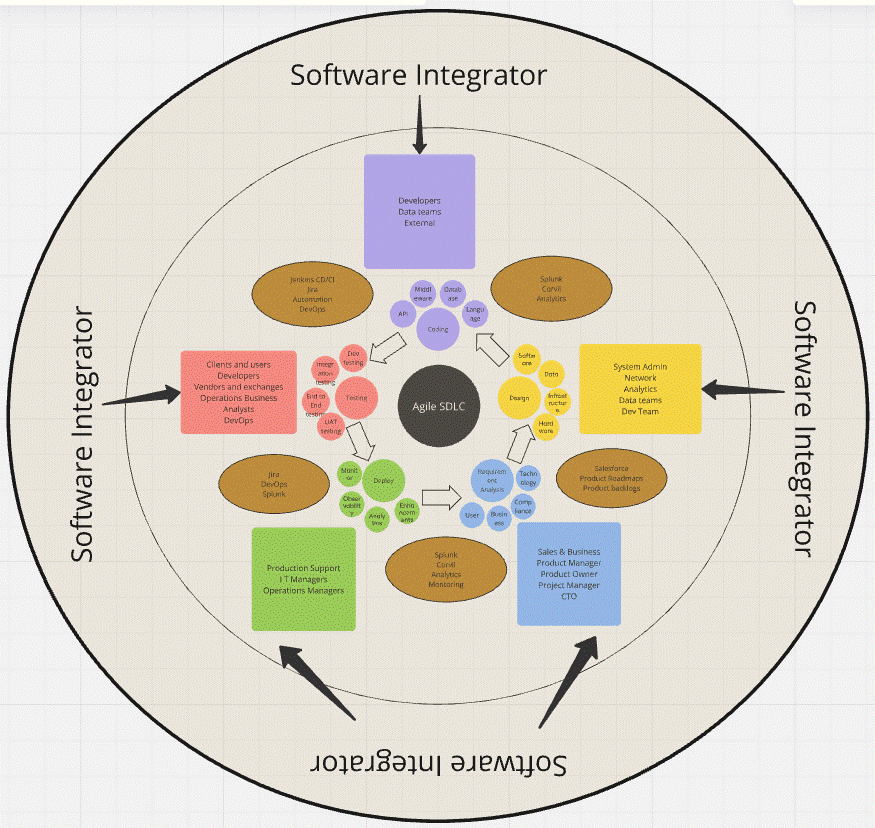
Importance of the Software Integrator in Agile SDLC:
- Accelerates Delivery: By automating builds and integrations, the Software Integrator helps maintain a steady flow of deliverables, aligning with Agile’s iterative approach.
- Reduces Risk: Continuous integration practices catch issues early, reducing the risk of major defects during later stages.
- Enhances Collaboration: The integrator fosters a collaborative environment, bridging gaps between development, testing, and operations teams.
- Supports Quality Assurance: Their focus on integration testing ensures that the software meets functional and performance standards across modules.
- Enables Continuous Improvement: By facilitating feedback loops and monitoring, the Software Integrator contributes to Agile’s emphasis on continuous learning and adaptation.
A Software Integrator in Agile SDLC ensures that all moving parts of the software system come together seamlessly, supporting frequent releases, high-quality delivery, and collaborative development. Their role is pivotal in enabling CI/CD pipelines, maintaining system stability, and driving efficiency in the Agile process.
We need your consent to load the translations
We use a third-party service to translate the website content that may collect data about your activity. Please review the details in the privacy policy and accept the service to view the translations.